Posted on

Herman Miller My Studio Cubes

The cubicle or cube has long either been revered or scorned, and there doesn’t seem to be an in between. Maybe it’s all the movies of drudgery being done in office cubicles that causes the scorn. After all the old style cubicles have become their own matrix world.

The Stereotype

The stereotype for the old cubicle is that everyone is like a mouse on a wheel. Or that everyone works like drones stamping widgets. It speaks to not being comfortable and having four white walls with the view of feet sticking out on all sides.
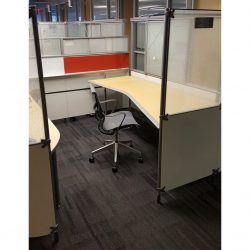
Herman Miller My Studio 8x8 - V DeskSure, the boss in the old movies in the above scenario gets an office and feels at home. The boss is comfortable. The office of the one in charge is big enough to have lunch brought into it. The employees eat tuna or cheese sandwiches on cramped desks that don’t even have room for a real plant.

But there is a modern, cozy, eloquent design which will be explained later that breaks this mold and stereotype. It gives the employee comfort, functionality and a classy home-style feel for his or her workspace.

Now cubicles were designed to give the employee privacy to work at the job with fewer interruptions. Cubicles in actuality can be personalized too by adding photos, material fabrics on the walls, curtains and anything else to make them more comfortable too and less sterile. Also, cubicles can be formed into pods of various numbers. The stereotype given above really never all that true for a long time. Cubicles in modern offices aren’t tin cans anymore.

Maximizing Space

So, cubicles will fit more employees into less space which is helpful if an office which isn’t an overly large one. The company then can have the staff that is needed to do the assignments given to it to help customers and not pay the rent for a bigger space.

Another option instead of cubicles is the open space concept. This is where all the workers are side by side in rows. The problem with this concept is that there is a lot of noise and intermingling of workers. Distractions can abound. Some people wear earbuds and play music to drown out the noise and confusion though. Imagine looking across from someone all day long or sitting within elbow reach of another person though? Some office workers aren’t happy with this type of workspace either. It can feel like a cafeteria setting if done in the wrong way.

Herman Miller My Studio 8x8 - Pods of 10Then there’s the combination of both for the workspace; using both the cubicle for people who need their privacy to work and open space for people who like to work in the open space concept. You even have cubicles just used for brainstorming often, or the breakroom The problem though can be that the brainstorming room becomes the timeout room for just plain old goofing off. Anyway, It can be difficult sometimes to make a work area where everyone is happy about everything.

But if you do go with cubicles using the concept of the cubicle only, or the combination of the cubicle and open space work environment, there is a cubicle that is designed to be functional and cozy. This is the My Studio Environments by Henry Miller. It takes the matrix out of the cubicle, and it’s eloquent too.

Cubicles with Privacy

TheMy Studio Environments by Herman Miller are cubicles which are comfortable then. They have a V Desk work surface and a bullet top workstation. Their sliding glass doors are frosted and the cubicle’s glass panels are frosted for privacy. There’s a whiteboard for note taking. The color is tan with maple tops, and the dimensions are Spine 8′ x Wing 8′ x Spine height 54″ x Wing height 65. ″

The thing about these cubicles is that they give the feeling of working in a private office. They look both modern and eloquent. Throw in the family pictures and designs on the wall, and everything fits into place. Not just because of the added things the employee brings but because the whole design is eloquent, and the personalized touch is the bonus.

With the purchase of a Herman Miller My Studio Cube, employees will work better and have a peaceful environment.

References:

https://nationalofficeinteriors.com/office-furniture/cubicles/herman-miller-my-studio/ 

Posted on

Privacy and Team Stations

One of the problems with working in an office is that people who don’t like being crowded can become stressed as more people enter a room. Now people’s idea of space and how they feel about being crowded comes from individual preferences, gender and cultural background. As examples below:

  • If a room has high ceilings or mirrors on the wall, as well being brighter and lighter, people will   feel less crowded in it as people come into the room. But in those conditions, men will feel more crowded than women because men tend to have better peripheral vision.
  • If a person works in a high-rise building on the lower floors, they are more likely to feel crowded then someone who works on the upper stories and has better access to daylight and better views.

To reduce these feelings of being crowded, furniture is used along with pillars, decorative items or plants. This can prevent people from becoming distracted in a room or feeling crowded as more people come into a room. Also, to prevent this feeling among employees, they can be assigned to individual Team Stations with their own private spots to do that which is needed of them too.

Why Team Stations by Teknion

Teknion Leverage Cubicle StationTo help reduce the effect that having too many people in too small of a space creates, you can have the openings of your employees’ work stations positioned so that their view of other co-workers is minimized. Because when working in an office today, an employee needs to be able to concentrate as well collaborate without distractions as life is faster paced today. With a private work station though, this allows employee a choice of when to concentrate and when to talk with other co-workers.

Teknion sells these kinds of work stations called team stations. With these Team Stations by Teknion there is a file pedestal per each station. They have upholstered wall panels which makes things a little quieter with noise, as well as laminated work surfaces and a monitor arm to hold screens in each station. These stations are sold in pods of four with dimensions of 5’x5’x51” tall for seating privacy. A choice of fabrics is offered such as India Poona Fabric and Peru Casma Accent Fabric with white Matrix laminate and platinum paint.

Now everyone of your employees is different, and the perfect working environment is one which gives employees the choice dealing with how much stimulation they are subjected to. Also, having an office that still has places for employees to take breaks to either socialize or take 5-minute breathers is optimal. The 5-minute breather is not a traditional break. It is when team members can go off by themselves to think about the next step in a private setting.

Strategies in the workplace

Not all your employees are alike, some can work in a lot of busy confusion and some can’t. So, the proper work setting will help to support the many work functions your employees do and the environment that they can do their work in. So, providing different zones for different work functions can be helpful for your employees:

  • Teknion Leverage Workstations DrawingIf the work is focused: Have spaces for concentrated work such as the Team Stations, or provide quiet zones for employees who are concentrating.
  • Collaboration among employees: Provide settings which are diverse for small group collaborations on projects and tasks.
  • Learning always: You can make your business an educational environment which supports mentoring and learning. This can be done by providing in-person, one-on-one learning and e-learning.
  • Socializing spaces for coworkers: If you provide informal spaces which can be used for both work as well as casual conversation, this will also foster innovation and informal collaboration.
  • Provide the technology: When employees are in their Team Stations, provide headsets that have white noise or sound masking options so that employees can focus on important work
  • Have teams: By using the Team Stations of four pods or more, you can create a team neighborhood, giving the feeling of team unity and a sense of place. This reinforces among your workers employee engagement and fosters the exchanging of ideas.

By giving your employees their own personal spaces as well as an area to collaborate when needed, you will have a better functioning team or teams of employees in your organization.

Reference:

http://www.hok.com/thought-leadership/workplace-strategies-that-enhance-human-performance-health-and-wellness/

https://nationalofficeinteriors.com/product/5-x-5-leverage-team-stations-by-teknion-sold-in-pods/

https://www.wbdg.org/resources/changing-nature-organizations-work-and-workplace

Posted on

How to Design Open Spaces While Incorporating Management

Used 58" Mobile White Board and Fabric Bulletin Board, White and Light Tan

Open spaces are very popular with office designers because they are motivating for employees and foster a team environment. These types of floor plans are also becoming widespread as companies strive to foster collaboration among employees. Open spaces have other advantages. They allow for impromptu meetings. Employees have more chances to interact with each other which helps them form strong relationships, especially with people they may not work with on a regular basis.

Despite the advantages of open spaces, there still needs to be room for privacy in every type of office. Open spaces can be noisy and they make it hard for many people to get their work done effectively. These floor plans can be especially challenging for managers, who often have to conduct business that requires a quiet environment. They may need to talk to upper management, vendors, salespeople and other individuals without outside noise or interruption.

Another one of the challenges that open spaces presents is privacy. Managers, in particular, need privacy to do their work. Why? Think about the many different types of meetings that managers need to have. They need places to conduct private, one-on-one conversations with employees. They need to talk to upper management about issues that aren’t appropriate to share with the rest of the team. Confidentiality is an important issue for management and can’t be underrated. It’s important that team members don’t overhear information that should remain private.

There need to be areas in the office for private sessions like performance appraisals where managers and employees can talk freely. Both parties want privacy and would feel restricted if they felt that they could be overheard. Sometimes, leaders need to give feedback to workers on how they’ve performed particular tasks. Whether this feedback is positive or negative, the need for a secluded place is the same. The employee may have questions that involve other team members. The person may want to discuss issues that are emotional or controversial. In these cases, you can see why privacy is critical for these conversations.

Productivity is another serious concern for management. Some of the tasks managers need to perform are compromised by constant interruptions. Most managers deal with interruptions by scheduling meetings with employees, vendors and workers in other departments instead of allowing people to drop by unannounced. However, when the floor space is open, managers are more likely to fall victim to constant interruptions. That’s why any floor plan needs to take the concerns of managers into consideration.

There are several ways to provide private spaces for leaders. Some companies set up private offices for managers. These let the person close the door when necessary, whether this is for meetings or so that they can concentrate on specific tasks. In other cases, the company may build cubicles in secluded areas for managers and supervisors. There is always the option of building a separate space entirely for all managers, but this will separate them from their teams, which is not ideal. It’s better if managers can be near their teams, while still having privacy.

If managers are in cubicles, they may still not have enough privacy for certain events, like performance appraisals or emotionally charged meetings with employees. They also won’t be able to freely discuss issues with other managers or upper management that should remain private. Many businesses choose to build small conference rooms in several places around the company so managers have a place to meet or make private conference calls when necessary. These rooms also help participants avoid disturbing people in the general office space.

There need to be an ample number of private meeting rooms, as many people will likely need them at the same time. People should rarely need to wait for a private room. This can cause frustration and a drop in productivity. It can also hamper a manager’s ability to schedule conferences with people in other time zones.

Larger conference rooms should be available for the general public. These rooms are important for larger meetings, video conference calls and phone calls that might disturb other people in the office. When the floor plan is open, it’s important to avoid loud meetings whenever possible. Conference rooms, whether large or small, help everyone concentrate.

Posted on

How to Create a Productive Work Environment

The goal of any workplace is to make the work environment as productive as possible. The way the office is laid out is critical to productivity. When you are considering purchasing office furniture, always keep productivity in mind. Worker productivity needs have changed dramatically over the years. Separate offices were the norm at one point because they conferred a sense of privacy and allowed employees to work in private. Offices gave way to cubicles over time so that companies could accommodate more workers in smaller spaces. Today, collaboration and communication are fundamental to creating productive work environments. The way you design your office can enhance or hamper your team’s ability to get work done.

Steelcase Answer 5x2.5 Used Cubicle w Glass in Grays and BluesShort cubicles are becoming popular choices. These cubicles have the advantage of providing a private workspace while still allowing users to collaborate with colleagues easily. These cubicles don’t have to line up side by side and cover the entire floor space of the office like more traditional cubicles did. Instead, the cubicles can be arranged in small pods or line the edges of walls, depending on your company’s needs and the work environment you want to create.
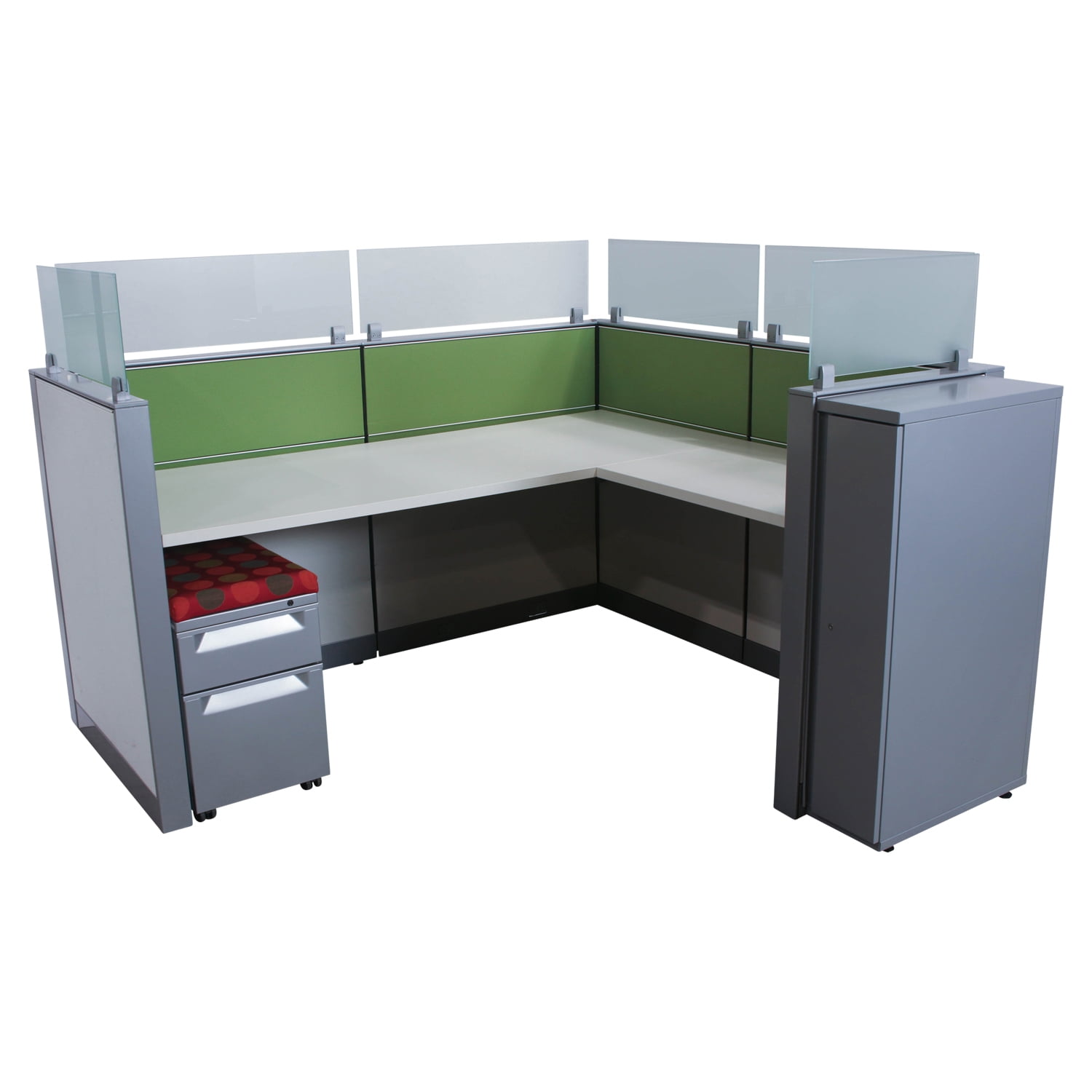
Short cubicles by Steelcase, Knoll and Herman Miller are popular for other reasons. They are often the office furniture of choice for call centers. They allow management to oversee the workers and look out for problems. Workers can simply raise their hands if they need support or assistance on a call. Short cubicles also work well when managers need to address a large team on a regular basis. Often, managers need to provide workers with updates and changes that team members need to know about to perform their jobs. Instead of calling workers away from their desks, they can simply speak to the group. This is much quicker than gathering the team in a conference room which may be extremely difficult if the group is large.

Short cubicles are also useful for training purposes. Often, learners need to access their computers during the training to understand and practice computer applications. The learners can sit at their desks and trainers can address the group as a whole so they can have access to their technology and practice new skills immediately.

Alternating private space and large collaborative areas is key to creating a productive work area. Collaboration is critical in many modern industries. People need to be able to connect with each other quickly. Sometimes, impromptu meetings are necessary. It is important to have office furniture that is conducive to this kind of collaboration.

Shorter or glass walled cubicles encourage rather than prevent communication. Office furniture like open-space conference tables makes it easy for teams to get together and spread out the materials they need to have a productive meeting.

Herman Miller 6x5 Used Canvas Cubicle, Green Apple - Sold in PodsAnother advantage to office furniture like shorter cubicles is that it can be quickly reconfigured to accommodate changing needs. Often, modern teams change rapidly. Workers need to move to new spaces or may temporarily relocate to a different space for a specific project. Your office furniture needs to accommodate these types of changes so that team movement and changes in size are simple to accommodate. Offices tend to change character quickly when teams change so you should create a space that is tailored to make changes.

Despite the importance of collaboration in the work environment, every office needs private spaces for a variety of reasons. Managers need to provide employees with feedback and support. People need to meet about delicate issues and they need a quiet space with complete privacy. Employees and managers need a space to make private calls or discuss confidential information. In other cases, a group needs to meet and has concerns about disturbing the larger office group. It’s important to have small offices or conference rooms that are set up to meet these needs. Sometimes, it’s necessary to have technology in the room. You’ll need office furniture like desks and chairs that make using technology simple for everyone. In other cases, you make need a large conference table to accommodate a large group. You’ll need to evaluate the special circumstances in your office environment to decide how much private meeting space you need and what office furniture is necessary.

Posted on

How to Create an Inspiring Work Environment

Productivity is a pressing concern in every workplace. Business owners and managers are constantly looking for ways to support their employees so that they can be as productive as possible. They restructure teams, bring in new technology and try dozens of other techniques to improve worker output. However, one of the most important parts of productivity often gets overlooked: the environment. Workers cannot do their best in an environment that hampers collaboration, communication and their ability to request and receive assistance quickly.

Office design has an enormous impact on employee psychology. At one time, companies focused on maximizing space by setting up cubicles and office furniture that were closed in and private. While it's important for employees to have privacy at times, but they shouldn't feel isolated. Rows and rows of cubicles create a sense of remoteness that can create distance among co-workers. Often, the coloring of cubicles is gray and dull and makes People are not likely to collaborate nearly as much in this sort of environment.

Many offices have learned that they need to build an environment that fosters employee interaction. You need to focus on several elements of the workspace to create an environment that is inspiring and motivating. What is your office's color scheme like? Is it dark and drab? Many offices use shades of gray and taupe because they are easy to match and are commonly believed to be less distracting. These color schemes typically have a negative effect on employee psychology. The lack of light and brightness can be depressing and uninspiring.

Natural colors such as white and light beige can improve the tone of offices dramatically. The floor coverings are important as well. The carpeting or other flooring should look fresh and clean. It should blend in naturally with the rest of the room. Natural light is another key factor. Fluorescent lights cannot replace the effect of real lighting. Whenever possible, incorporate as many windows as possible. Do not block the view of windows with office furniture. When window access isn't possible or the weather doesn't provide light, place lamps around the office to cheer up the environment.How to Create an Inspiring...

Break-out spaces are becoming increasingly important in many workplaces. These are locations where teams can talk, plan and collaborate. The office furniture in these spaces should accommodate the tools workers need to be productive including laptops, whiteboards, flipcharts, papers and phones. Break-out rooms should be open enough to encourage interaction while still proving some privacy. The rooms should also be removed enough from other work stations so that other employees don't get distracted.

Another popular trend in modern offices is short cubicles designed around more open spaces. Short cubicles don't block workers' views of the rest of the work environment. They aren't as isolating and they help people build rapport with their team members. They can see each other easily when they are standing or talking. Modern jobs rely more on input from team members than those of the past. You can find a variety of lower cubicle styles that will accommodate the appropriate office furniture.

Good office furniture can help improve performance by making workers more comfortable. Worn-out and uncomfortable chairs can make it difficult for people to concentrate. If they don't have adequate storage space in their office furniture, they will quickly become unorganized which decreases productivity. Instead of being able to easily access what they need, they'll have to repeatedly look for items to work. Desk size and style are important to comfort. When they are the wrong size, it's frustrating for employees.

Appropriate office furniture is important for offices and other areas. Your office should have private spaces for all employees to retreat to when they need to make phone calls or talk-on-one with someone. The area should have a door or privacy panel and it should either have a door or enough distance to ensure that conversations are private. Many companies design small offices for this purpose. They equip the rooms with office furniture such as a few chairs, tables and room for laptops and phones.

Conference rooms need appropriate office furniture. Because these rooms are used for large meetings, there should be adequate seating for all attendees. It sends the wrong message if some employees have to stand during group events. Other important office furniture pieces include suitably-sized conference tables, stands for snacks and beverages and tables for meeting materials. These, and other pieces of office furniture, can make your business considerably more productive.